Employment LegislationChanges In 2026 WhatEmployers Need To Know
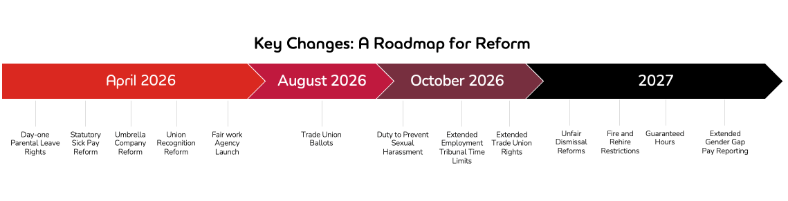
Throughout 2026, UK employment law is set to undergo one of the most significant reforms in decades, primarily as a result of the Employment Rights Act 2025 (ERA). Employers will feel the changes across almost all areas of their business, including compliance, parental rights, sick leave, industrial relations and overall workplace culture. With some reforms taking effect immediately and others developing over time, understanding their impact and required actions will be key to maintaining stability.
April 2026 Changes And Implications
Day One Rights: Family Leave
Change: From 6 April 2026, employees will gain access to Paternity Leave and Unpaid Parental Leave from day one, removing previous service requirements. The reform aims to make work more accessible, supporting 1.5 million parents and enabling 32,000 fathers to take leave immediately1.
Impact: In practical terms, employers may begin to receive leave requests from new starters. Onboarding materials, HR policies and manager guidance will therefore need updating to reflect any earlier entitlements. Organisations should also expect more discussions about leave options and potentially varied absence patterns.
Action: Forward-looking employers are already mapping out how roles can be covered temporarily, whether it's through cross-training, internal mobility or short-term hires. Recruitment partners can also play a valuable role here by helping employers access trusted temporary support quickly, ensuring that teams remain stable should more employees make use of day one parental leave.
Statutory Sick Pay
Change: Fundamental reforms to Statutory Sick Pay (SSP) are set to come into force from 6 April 2026, as the Lower Earnings Limit will be removed, making SSP available to all employees, irrespective of earnings. The three-day waiting period will also be removed, meaning SSP will also become payable from the first full day of sickness absence.
Impact: Data Suggests that 43% of employers and 36% of employees identified changes to SSP as having the greatest workplace impact2. By removing waiting days, the reforms aim to reduce presenteeism as employees feel less pressure to work while unwell. While these changes may improve long-term wellbeing and productivity, they will also require payroll and HR systems to adapt. Employers with large variable hours workforces may experience the most noticeable change.
Action: Organisations should review and adjust internal policies and payroll procedures to ensure all day one SSP payments are correctly calculated. Managers and HR functions should also be provided with accessible guidance on how sickness should be reported, what needs to be recorded and how best to support employees in their absence. For employers, planning ahead with talent providers for potential changes in absence patterns will help maintain operational stability and reduce the risk of any unexpected staffing gaps.
Umbrella Company Reforms
Change: From 6 April 2026, new legislation will reform how umbrella companies are regulated, introducing joint and several liability for unpaid PAYE and National Insurance contributions (NIC). Crucially, there will be no "reasonable steps" defence, meaning that if the umbrella company defaults, the agency or client is liable regardless of any due diligence they have undertaken.
Impact: The change means that both the umbrella company and the client or agency using their services will be held responsible for ensuring tax and National Insurance contributions are correctly paid. Affecting approximately 700,000 people who work through umbrella companies, the reform is intended to enhance worker protections and reduce tax gaps3. For employers there is likely to be greater scrutiny and increased expectations around transparency.
Action: Employers should consider strengthening compliance by reviewing how umbrella providers are used in their supply chains and ensuring that robust due-diligence checks are in place. Contracts should be updated to include appropriate protections around PAYE and NIC, and clear communication with contingent workers about any changes will be essential as the wider 2027 framework develops.
Union Recognition Reforms
Change: From 6 April 2026, the Employment Rights Act will lower the thresholds that unions must meet to gain statutory recognition. Unions will no longer need to show that most workers in the proposed bargaining unit are likely to support recognition, and recognition ballots will require only a simple majority of votes4.
Impact: The changes make it much easier for unions to secure statutory recognition, even in workplaces where support is moderate rather than majority-driven. Employers are also likely to see more recognition campaigns, quicker decision-making, and a higher chance that unions will gain formal bargaining rights. This may increase union presence and lead to more collective bargaining obligations across workplaces.
Action: Employers should review their employee relations strategy and strengthen internal communication to ensure employees feel informed and engaged. Managers should be trained on how to respond appropriately to union activity under the new rules.
Fair Work Agency
Change: From 7 April 2026, the new Fair Work Agency will bring together enforcement of key employment rights into one place. It will regulate employment agencies and licensing, enforcing rules around the National Minimum Wage, SSP and holiday pay, and act on labour exploitation. Data suggests around 20% of workers paid at or near the minimum wage are underpaid, and 1.8 million do not receive a payslip. Many low-paid migrant workers also struggle to access information about their rights, highlighting the scale of compliance risk and the potential benefits of stronger protections5.
Impact: The Agency's expanded remit may mean more proactive investigations, stronger enforcement activity and greater emphasis on transparent pay, ensuring safer working conditions. Employers can also expect better access to guidance and support through the agency.
Action: Employers should check that labour supply processes and documentation are accurate and regularly updated. Strengthening due-diligence procedures and ensuring clear contracts with labour providers will also help reduce risk and potential liability.
Autumn 2026 Changes And Implications
Trade Union Rights
Change: From October 2026, several reforms under the ERA will strengthen workplace trade union rights. Employers will be required to inform all workers of their legal right to join a trade union, providing a written statement at the start and at set intervals of their employment. Trade unions will also gain updated rights of access to the workplace, allowing them to engage with workers to discuss membership, representation and collective bargaining. Research indicates that this is a step in the right direction as employers with union representation are much more positive about unions, with 70% describing relations as positive or very positive6.
Impact: Employers may see increased union presence, more structured requests for facility access and more employees exercising their rights to representation. Workers will also have increased rights to take paid time off within working hours to carry out their trade union duties.
Action: Employers should review onboarding processes to integrate the new union-rights statement and check that internal communication channels are compliantly updating employees at agreed intervals. Clarifying on-site protocols, visitor procedures and points of contact, will additionally help maintain smooth operations with trade unions.
Harassment Prevention
Change: From October 2026, employers will face an increased legal duty to take "all reasonable steps" to prevent sexual harassment replacing the existing requirement to take "reasonable steps". Additionally, employers will be liable for third party harassment unless the employer took all reasonable steps to prevent it.
Impact: Organisations will need to actively demonstrate a proactive strategy to identify and reduce harassment risks across all parts of the business. In client-facing sectors, the new third-party liability may present the greatest impact, as employers must also anticipate potential risks arising from customers and service users.
Action: Organisations should review anti-harassment policies, conduct thorough risk assessments and provide meaningful training for managers and employees. Reporting channels must be clear and accessible. Where employees interact with third parties, employers should also update contracts and client agreements to minimise risk and ensure expectations are clearly set.
Extended Employment Tribunal Time Limits
Change: From October 2026, the ERA will give employees more time to bring claims forward to Employment Tribunal. Under the proposed changes, the time limit for most tribunal claims will be extended from three months to six months. This would apply to key claim types, including those for discrimination, unfair dismissal and harassment.
Impact: The longer filing period is expected to lead to more claims as employees will have twice as much time to reflect on their experiences, while for employers, it may result in a longer period of uncertainty after an employee leaves. Organisations should be prepared for cases to relate to events further in the past, which can make evidence gathering more challenging and time consuming.
Action: Employers should strengthen documentation and record keeping practices and ensure any processes for grievances, disciplinaries and exits are thorough and consistent. Providing managers with clear guidance on note-taking and case handling will help organisations stay prepared as the longer period comes into effect.
What To Expect In 2027...
Looking ahead to 2027, employers can expect to experience continued changes to regulation and employee rights. From 1 January 2027, protection from unfair dismissal will become a right from six months of employment, reducing the qualifying period from the current two years. Further, dismissing an employee and then reengaging them to impose certain key contractual changes (fire and rehire) will be automatically unfair in most cases.
2027 will also see further reforms come into force including increased pregnancy and maternity rights, guaranteed working hours, extended flexible working rights, expanded gender pay gap reporting obligations and revised collective redundancy protections. Collectively these developments will continue to reshape the employment landscape and staying informed on legal updates throughout 2026 will be essential.
Adecco is actively participating in consultations with government and industry bodies to help shape practical, evidence-based workforce policy. This involvement enables Adecco to offer tangible support to employers by translating new requirements into clear guidance and practical steps for implementation, helping organisations prepare confidently for the changes ahead.
Key Employer Priorities Include
Reviewing and updating policies, contracts and handbooks
Ensuring payroll, HR systems and reporting processes reflect new entitlements
Training managers to apply changes consistently and confidently
Improving documentation and compliance processes
Assessing workforce planning strategies to manage increased leave and absence
Strengthening agency relationships
With significant legislative change taking effect in 2026 workforce planning has never been more critical. If you would like to discuss how these changes may impact your organisation and build resilience into your talent strategy, contact Adecco to speak with one of our workforce specialists.